Professional Disaster Cleaning Services UK
Facing the destructive aftermath of a flash flood, an intensive property fire, a major burst pipe, or a severe sewage backup is an incredibly overwhelming and stressful experience. Beyond the immediate structural devastation, properties impacted by environmental disasters harbor hidden biological and structural hazards that threaten human health. Standard commercial or domestic cleaning methods are completely inadequate for these high-risk scenarios. Across the United Kingdom, turning a compromised building back into a safe environment requires specialist structural knowledge, industrial machinery, and strict legal compliance. Relying on professional disaster cleaning services is the only way to safely mitigate secondary hazards, extract dangerous elements, and completely rebuild your peace of mind.
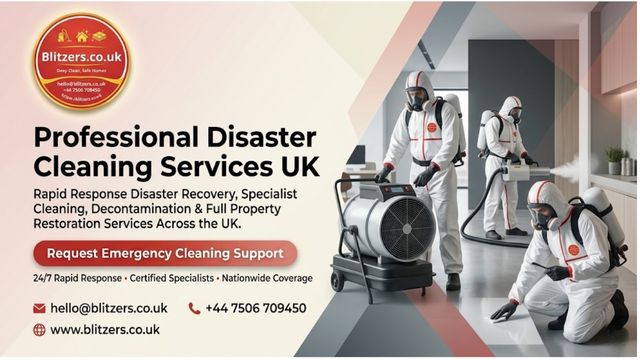
In the specialist property restoration sector, a disaster site involves unexpected environmental factors that compromise safety, habitability, and structural soundness. This includes standing water containing dangerous chemical runoff, toxic black water from sewage overflows, corrosive soot layers from electrical fires, and rapid microbial growth.
When a property is compromised, toxic residues quickly settle deep within porous structural fabrics, structural cavity spaces, and wall foundations.
The Invisible Dangers: Pathogens, Corrosives, and Toxins
Attempting to tackle fire soot or flood sludge without heavy-duty protection and specialised training presents severe health and physical safety risks. Left untreated, soot acts as a highly acidic compound that permanently etches surfaces, while trapped moisture breeds toxic mould within 48 hours.
The 4-Stage Property Disaster Decontamination Framework
To successfully restore a property to pre-loss condition, certified industrial technicians deploy a strict four-stage structural remediation strategy.
1. Rapid Structural Appraisal and Safety Containment
Before any restoration work begins, senior technicians complete a thorough structural and electrical risk assessment. They map out the spread of moisture or soot and isolate hazards. The crew equips themselves with heavy-duty Personal Protective Equipment (PPE), including Type 5/6 biohazard suits, protective steel boots, and advanced air-purifying respirators.
2. Extraction of Standing Water, Soot, and Corrosive Residues
Technicians immediately deploy industrial truck-mounted pumps to extract standing water, or use specialised negative-pressure vacuums to safely trap dry soot. Damaged building materials, such as saturated drywall, ruined carpets, and contaminated insulation, are systematically stripped out. All hazardous materials are categorised and tracked using official waste transfer notes, in full compliance with the UK Environmental Protection Act.
3. Industrial Washing and Deep Surface Sanitisation
Once the bulk debris is removed, hard surfaces undergo intensive mechanical cleaning. Technicians apply commercial-grade, broad-spectrum virucides and specialised soot-neutralising agents. These EN-certified formulas eliminate biological contaminants at a cellular level and neutralise acidic chemical films without damaging the property’s underlying structure.
4. Advanced Structural Drying and ULV Antimicrobial Fogging
The final phase focuses on deep environmental stabilization. Technicians install heavy-duty industrial dehumidifiers and air movers to pull deeply embedded moisture from brickwork and timber supports.
The process finishes with Ultra-Low Volume (ULV) Antimicrobial Fogging, which releases a ultra-fine mist of sterilising droplets. This mist flows into inaccessible ceiling voids, structural cavities, and ventilation ducts to destroy airborne bacteria and eliminate lingering smoke or sewage odours permanently.
Legal Compliance and Discretion Across the United Kingdom
Operating a business or letting a residential property in the UK carries strict health and safety responsibilities under the Health and Safety at Work Act and COSHH (Control of Substances Hazardous to Health) regulations. Disposing of disaster waste or hazardous sewage sludge in standard domestic bins is illegal.
Hiring fully accredited experts guarantees you receive an absolute, legally binding paper trail, including a Certificate of Decontamination. Furthermore, professional disaster teams operate with utmost sensitivity, deploying unmarked commercial vehicles when requested to maintain complete privacy within your neighborhood.
Customer Reviews
Discover how homeowners, insurance managers, and commercial operations across the UK have successfully salvaged their properties using our premium disaster restoration solutions.
⭐⭐⭐⭐⭐ Name: Oliver Bennett City: London Service: Fire Damage Cleaning Review: “The property looked significantly restored after the cleaning.”
⭐⭐⭐⭐⭐ Name: Eleanor Finch
City: Manchester
Service: Flood Damage Restoration
Review: “Our ground floor was completely submerged by a burst river bank. This team arrived within hours, extracted the mud, dried the walls, and fully sanitised the space.”
⭐⭐⭐⭐⭐ Name: Marcus Sterling
City: Birmingham
Service: Sewage Cleanup & Sanitisation
Review: “A severe sewage backup created an unmanageable hazard in our commercial basement. The technicians neutralised the odours and biological risks perfectly.”
⭐⭐⭐⭐⭐ Name: Fiona McGregor
City: Glasgow
Service: Emergency Water Extraction
Review: “Outstanding response time during a major storm. They set up heavy-duty pumps and industrial dehumidifiers to save our timber structural joists from rotting.”
⭐⭐⭐⭐⭐ Name: Thomas Wright
City: Leeds
Service: Soot and Smoke Decontamination
Review: “Following an electrical kitchen fire, our entire home was covered in oily soot. The crew scrubbed every wall and ceiling perfectly, leaving it completely ready for decoration.”
⭐⭐⭐⭐⭐ Name: Sian Evans
City: Cardiff
Service: Industrial Flood Remediation
Review: “Professional, transparent pricing, and highly detailed risk assessments. They handled a massive industrial site water leak with complete efficiency.”
⭐⭐⭐⭐⭐ Name: Harrison Boyd
City: Belfast
Service: Structural Drying Service
Review: “The team monitored our property’s moisture levels every single day using advanced digital meters. Absolute peace of mind throughout the entire drying cycle.”
⭐⭐⭐⭐⭐ Name: Chloe Jenkins
City: Bristol
Service: Post-Fire Blast Cleaning
Review: “They completely removed stubborn smoke damage from our exposed brickwork. The internal air quality feels fresh, clean, and perfectly safe again.”
⭐⭐⭐⭐⭐ Name: Alexander Green
City: Liverpool
Service: Basement Sewage Extraction
Review: “Dealt with a highly complex, contaminated basement water issue smoothly. Full Environment Agency waste transfer documentation was provided automatically.”
⭐⭐⭐⭐⭐ Name: Charlotte Hall
City: Newcastle
Service: Flash Flood Cleanups
Review: “The team worked tirelessly through the night to clear toxic silt from our retail premises. They saved our trading week from absolute disaster.”
⭐⭐⭐⭐⭐ Name: William Davies
City: Sheffield
Service: Commercial Disaster Restoration
Review: “A highly trusted specialist company that coordinates directly with your insurance company. They made a very stressful corporate event incredibly straightforward.”
⭐⭐⭐⭐⭐ Name: Amelia Carter
City: Nottingham
Service: Black Water Clean & Sanitise
Review: “Eradicated all toxic elements and damp risks following a severe mains plumbing failure. Absolute professionals who I would highly recommend.”
⭐⭐⭐⭐⭐ Name: George Mitchell
City: Southampton
Service: Smoke Damage Odour Eradication
Review: “The final ULV antimicrobial fogging treatment completely knocked out a persistent, chemical smoke odour that regular cleaning could not touch.”
⭐⭐⭐⭐⭐ Name: Lily Campbell
City: Edinburgh
Service: Emergency Storm Damage Cleanup
Review: “Meticulous attention to detail under incredibly hazardous site conditions. The field crew kept us updated through every single phase of work.”
⭐⭐⭐⭐⭐ Name: Benjamin Parker
City: Coventry
Service: Toxic Silt & Debris Clearance
Review: “Safely removed large quantities of contaminated mud and ruined drywall panels. Excellent industrial equipment and flawless health protocols.”
⭐⭐⭐⭐⭐ Name: Freya Johnstone
City: Aberdeen
Service: Major Leak Water Restoration
Review: “Clear fixed pricing, zero hidden costs, and highly trained specialists. They made an unmanageable structural leak completely disappear.”
⭐⭐⭐⭐⭐ Name: David Morgan
City: Swansea
Service: Retail Space Disaster Cleaning
Review: “Returned our shop floor to an immaculate, hygienic standard after a major plumbing disaster over the bank holiday weekend. Exceptional work.”
⭐⭐⭐⭐⭐ Name: Sophia Taylor
City: Leicester
Service: Fire Smoke Deodorisation
Review: “Wonderful service from polite, professional technicians who treated our damaged belongings with real care, dignity, and high respect.”
⭐⭐⭐⭐⭐ Name: Joseph Adams
City: Dundee
Service: Warehouse Flood Decontamination
Review: “Hit all high-frequency areas with EN-certified biocide treatments. Their technical expertise regarding structural moisture profiling was excellent.”
⭐⭐⭐⭐⭐ Name: Emily Fletcher
City: Plymouth
Service: Trauma and Disaster Scene Washdown
Review: “An elite level of deep sanitisation care during a highly traumatic property crisis. They restored total structural safety to our property quickly.”
Frequently Asked Questions (FAQ)
1. What exactly are professional disaster cleaning services?
Professional disaster cleaning services involve the highly specialised containment, clearance, sanitisation, and drying of properties affected by severe environmental incidents. This includes intensive property fires, clean or black water flooding, structural sewage backups, and flash environmental damage.
2. How quickly can a disaster restoration team respond to an emergency flood or fire?
Most leading UK disaster restoration networks operate on a 24/7 emergency footing. Specialized response teams are available every single day of the year, including public holidays, and typically arrive on-site within a few hours to mitigate damage and protect structural assets.
3. What is the difference between “clean water” and “black water” in flood disasters?
Clean water originates from broken supply pipes and presents minimal initial biological risk. Black water describes highly hazardous flooding from rivers, ground surface runoff, or sewage pipes. Black water contains toxic chemicals, fecal matter, parasites, and pathogenic bacteria that require advanced industrial disinfection.
4. Why is smoke and soot damage considered hazardous after a fire?
Soot particles are highly acidic and chemically complex. Inhaling lingering ash dust can cause respiratory problems, while the chemical compounds can permanently corrode and stain metals, glass, and wall surfaces if they are not neutralized with specialized solutions immediately.
5. Do disaster cleaning services handle the drying of structural assets?
Yes. True disaster restoration involves utilizing advanced diagnostic equipment like non-penetrating moisture meters and thermal cameras, alongside high-capacity industrial dehumidifiers and air movers, to extract deep moisture from masonry and building timbers.
6. Are disaster cleanup services in the UK covered by commercial or home insurance?
Yes, in the vast majority of cases. Most comprehensive building insurance frameworks, commercial trade protections, and landlord indemnity packages cover the costs of emergency water extraction, structural sanitisation, and professional fire restoration services.
7. What regulations govern the disposal of disaster-affected hazardous waste?
Disaster waste management is strictly governed by the Environmental Protection Act and COSHH regulations. Contaminated building fabrics, sewage sludge, and fire debris must be logged, carried by an upper-tier licensed waste provider, and disposed of at authorised processing facilities.
8. How do disaster cleaners eliminate persistent smoke and sewage odours?
Specialists do not rely on standard aerosol air fresheners to temporarily hide odours. Once all contaminated structural assets are cleared away, they deploy advanced Ultra-Low Volume (ULV) antimicrobial fogging machines or ozone generators to chemically break down odour molecules at a structural level.
9. Is it safe to remain inside a building during a major disaster cleanup?
In most cases of severe black water flooding or extensive fire smoke damage, it is highly recommended to vacate the area during the initial extraction and sanitisation phases. Occupants should wait until structural drying is complete and the indoor air is certified safe.
10. How are the costs for emergency disaster cleaning services determined?
Our estimation process is completely open, transparent, and direct. Pricing is calculated accurately based on the category of the disaster (flood, fire, or sewage), the total area affected, the volume of hazardous materials requiring legal disposal, and the specific drying machinery needed. We provide comprehensive, upfront quotes with zero hidden costs.